Where cascading domes rise one after another and soft blue tones filter the light inside, the Blue Mosque stands as both a masterpiece of Ottoman architecture and Istanbul’s most visited place of worship. With its six slender minarets and more than 20,000 İznik tiles, this 400-year-old mosque balances quiet spirituality with striking grandeur.
Commissioned by Sultan Ahmed I and built directly across from Hagia Sophia, the mosque forms one of the most iconic views in the city. Whether you’re interested in history, architecture, or simply experiencing a living place of faith, the Blue Mosque offers a rare window into the Ottoman world — still active, still meaningful today.
As a licensed tour guide who has been guiding visitors through Istanbul for almost 20 years, I created this blog to help travelers experience the city with context, clarity, and respect. In this guide, you’ll find everything you need to know about visiting the Blue Mosque in 2026 — from opening hours and dress code to practical tips that make your visit smoother and more rewarding.
📌 Blue Mosque 2026 Visitor Summary
A quick guide to visiting the Blue Mosque in 2026 — entrance rules, prayer times, dress code, and guided visits.
🏷️ Entrance Fee: Free for all visitors
⏰ Opening Hours: 08:30 – 17:30 (closed during prayers)
🙏 Prayer Closures: Twice daily (see exact hours below)
⏳ Average Visit Duration: 30–45 minutes
🌞 Best Time to Visit: 08:30 – 12:00 in the morning
🧕 Dress Code: Men should wear long shorts; women should bring a scarf
🎧 Guided Tours: Recommended for deeper insight (details available via the blue link below)
📍 Location: Sultanahmet, Istanbul
📅 Last Updated: January 2026
History of The Blue Mosque
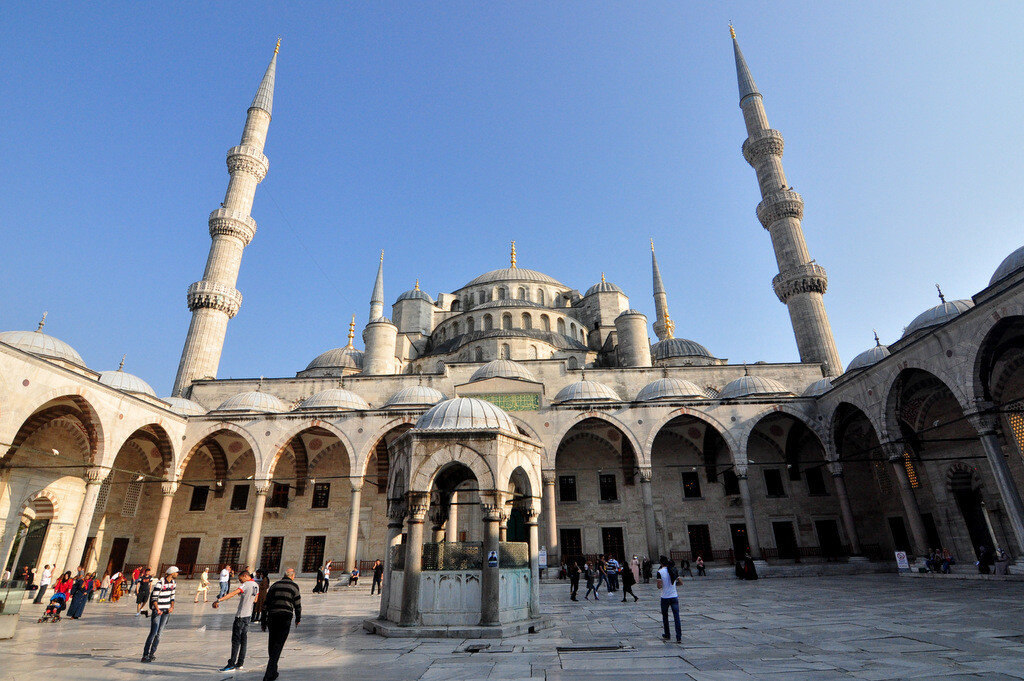
Built between 1609 and 1616, the Blue Mosque represents the final flowering of Classical Ottoman architecture. Commissioned by Sultan Ahmed I, the mosque was designed by Sedefkar Mehmed Agha, a student of the legendary Mimar Sinan.
By the early 17th century, Ottoman architecture had already reached its mature form. The architectural tradition that began in Bursa, developed further in Edirne, and reached its peak in Istanbul, found one of its last and most refined expressions in the Blue Mosque. Its balanced proportions, cascading domes, and harmonious courtyard layout reflect centuries of accumulated architectural knowledge.
Shortly after the mosque was completed, architectural tastes within the empire began to shift. From the 18th century onward, European influences such as Baroque and Neoclassical styles gradually entered Ottoman design. This transition can be seen in later monuments like the Nuruosmaniye Mosque, and became even more pronounced in the 19th century with structures such as the Dolmabahce Mosque and Ortakoy Mosque.
For this reason, the Blue Mosque holds a unique position in Istanbul’s architectural timeline — a graceful farewell to the classical era, before the empire turned toward new artistic horizons.
Blue Mosque Architecture
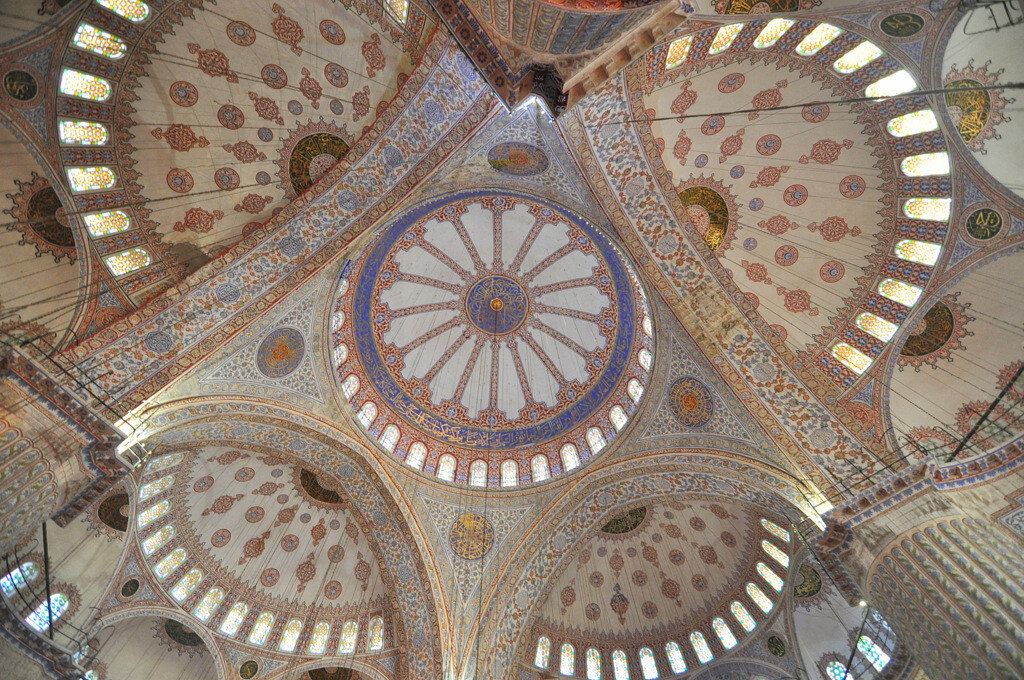
The architectural design of the Blue Mosque belongs to the palace architect Sedefkar Mehmed Agha. At first glance, what stands out most is the mosque’s layered dome structure. A large central dome is supported by four half-domes, which in turn flow into smaller quarter-domes, creating a smooth, cascading effect from the center toward the outer walls.
This descending rhythm of domes gives the mosque its distinctive silhouette. From the outside, the structure feels balanced and light despite its size — an effect that reflects centuries of Ottoman architectural refinement.
Sedefkar Mehmed Agha was trained in the circle of Mimar Sinan, the greatest architect of the empire. While designing the Blue Mosque, he drew inspiration from Sinan’s Şehzade Mosque, often considered one of the most harmonious dome compositions in Istanbul. Rather than copying it directly, Mehmed Agha adapted the idea and gave it his own interpretation, resulting in a more monumental and outward-facing design.
One of the mosque’s most striking features is its six minarets. In Ottoman architecture, mosques typically had two or four minarets, making this choice highly unusual for its time. The intention was clear: Sultan Ahmed I wanted to create a structure that could visually stand alongside Hagia Sophia, which had dominated the skyline for centuries.
Together, the cascading domes and six minarets give the Blue Mosque a powerful yet elegant presence — one that was designed not only to impress, but to define Istanbul’s skyline.
Interior of the Blue Mosque
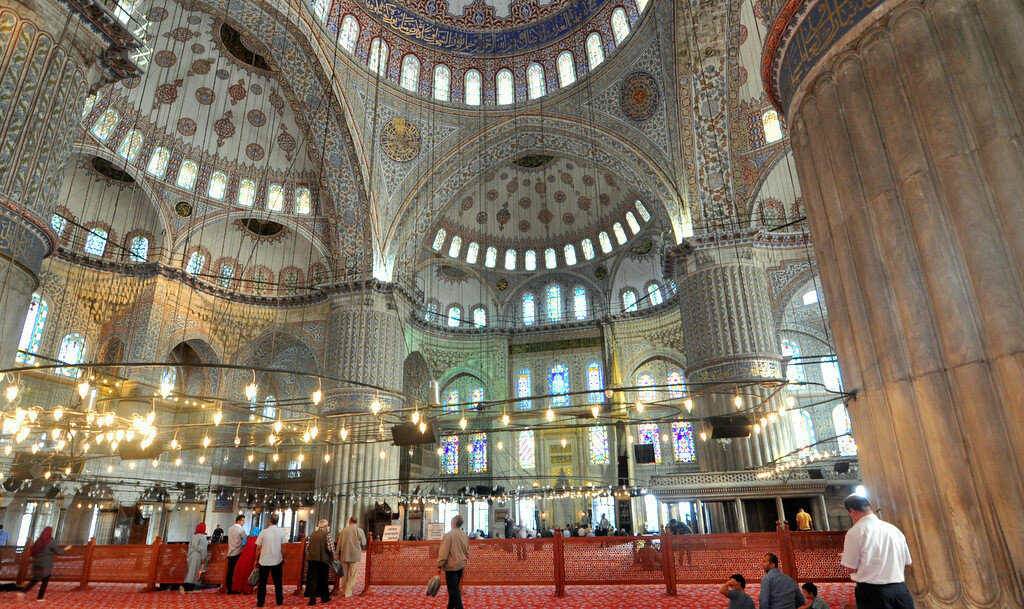
Stepping inside the Blue Mosque, the first elements to catch your eye are the massive stone columns supporting the central dome. Known as the “Elephant Legs,” these pillars carry much of the building’s weight, yet they never feel overwhelming. Carefully clad in marble and softened with delicate painted details, they blend strength with elegance.
From the tops of these columns, arches rise smoothly toward the dome, guiding the eye upward in one continuous flow. This layered transition creates a strong sense of unity inside the mosque — nothing feels abrupt or heavy, despite the scale of the structure.
The interior space feels open and deep thanks to the half and quarter domes extending to the sides. These domes not only shape the exterior silhouette but also expand the prayer hall, allowing light and space to move naturally across the interior. The result is a calm, balanced atmosphere that feels both grand and welcoming.
Although the Blue Mosque is often perceived as monumental, it is not the largest Ottoman mosque in Istanbul. That title belongs to the Suleymaniye Mosque, designed by Mimar Sinan. What sets the Blue Mosque apart, however, is its location and accessibility, making it the most visited mosque in the city and one of the most memorable interiors for first-time visitors.
Blue Mosque Opening Hours 2026
In 2026, the Blue Mosque is open to visitors daily between 08:30 AM and 5:30 PM, except during prayer times. For exact time slots and the best hours to visit, please check the visiting hours chart shared in the box below. This information was last updated on January 9, 2026.
🕌 Planning your visit to the Blue Mosque?
As of January 9, 2026, tourists can visit the mosque during the following time windows:
⏰ 08:30 – 12:15 |
13:45 – 15:15 |
16:15 – 17:30
🙏 Outside these hours, the mosque is closed to visitors due to prayer services.
How to Calculate Visiting Hours Yourself
A prayer times chart is displayed in the courtyard of the Blue Mosque, but if you prefer to plan ahead, you can also check the current prayer times on the official website linked here. Keep in mind that the mosque closes about one hour before each prayer and reopens roughly 30 minutes after the prayer ends. Using this simple timing rule makes it easy to calculate visiting hours for any day of the year.
The best time to visit the Blue Mosque is in the morning, shortly after it opens. Arriving around 08:30 AM gives you a clear advantage, allowing for a calmer experience before large tour groups arrive. Based on the daily prayer schedule, the most convenient visiting window is typically between 08:30 and 12:00, when access is least interrupted and the atmosphere remains peaceful.
🕌 Blue Mosque Guided Tour Options
The Blue Mosque is free to enter, but exploring it with a guide makes a huge difference. Learn about the history, tiles, and hidden stories of this majestic mosque — without getting lost in the crowd. Here are two great options below:
Small groups • Licensed guides • No pressure to rush • Top-rated experiences
Blue Mosque Entrance Fee 2026
There is no entrance fee to visit the Blue Mosque in Istanbul in 2026. Like all mosques in Turkey, access is free of charge for both tourists and worshippers. However, voluntary donations are welcomed. If you wish, you can leave a small donation at the designated kiosk near the mosque exit. This information was last updated on January 9, 2026.
Dress Code of the Blue Mosque
There is a dress code when visiting the Blue Mosque, as it is an active place of worship. Women are required to cover their heads, so bringing a scarf with you is a good idea. However, if you forget, there’s no need to worry.
At the entrance, free scarves and long skirts are available for women to borrow. Similarly, men wearing shorts are provided with a wrap to cover their legs. After your visit, you can simply return these items at the kiosk and continue your day comfortably in your regular clothes.
Then make sure to visit these other historical treasures nearby — each one offering a unique glimpse into Istanbul’s layered past:
- Hagia Sophia – A timeless marvel that bridges empires and faiths
- Topkapi Palace – The imperial residence of Ottoman sultans for 400 years
- Dolmabahce Palace – A dazzling 19th-century palace on the Bosphorus
- Basilica Cistern – Discover Istanbul’s mysterious underground world
- Galata Tower – Enjoy breathtaking views of Istanbul from above
How to Get to the Blue Mosque?
The Blue Mosque, officially known as the Sultan Ahmed Mosque, sits at the very heart of Istanbul’s Old City, directly facing Hagia Sophia across Sultanahmet Square. Surrounded by gardens, fountains, and centuries of layered history, its cascading domes and six slender minarets form one of the most recognizable silhouettes on the city’s skyline.
If you’re already in the Sultanahmet Square area, you’re essentially there. The square is fully pedestrian-friendly, and the mosque’s courtyard is easy to spot. Simply walk toward the large stone entrance beyond the fountains — the Blue Mosque rises just behind it.
Coming from Taksim Square? The route is simple and scenic:
- Take the F1 Funicular from Taksim down to Kabataş
- At Kabataş, transfer to Tram T1 (direction: Bağcılar)
- Get off at Sultanahmet — the ride takes about 15–20 minutes
- Once you exit the tram, walk past Hagia Sophia and cross the square; the Blue Mosque will be just to your right
No matter how you arrive — by tram, on foot, or through the gardens — the approach itself feels like part of the visit. From the sound of the call to prayer to pigeons circling the fountains, the path gently leads you into one of Istanbul’s most atmospheric and meaningful spaces.
Things to Do around Blue Mosque
There are many things to do around the Blue Mosque. After leaving the mosque, you can explore the centuries-old bazaars, visit interesting museums and even enjoy a Turkish bath in a historical hammam.
1. Arasta Bazaar

Arasta Bazaar is almost similar to the other two famous bazaars of the city, Grand Bazaar and Spice Bazaar. However, it is an open market with spacious streets. You can easily reach the bazaar from the courtyard of the mosque.
When a mosque was built in the Ottoman period, a bazaar was built right next to it. The maintenance costs of the mosque were covered by the rent collected from the shops in this bazaar. Arasta Bazaar is a place that keeps this tradition alive.
Inside the Arasta Bazaar is the Great Palace Mosaics Museum, one of the lesser known museums of Istanbul. Floor mosaics from the Great Palace of the Roman emperors can be seen in this museum.
2. Hippodrome
Hippodrome is one of the rare historical monuments from the Roman period in Istanbul. The Hippodrome was built by Emperor Constantine when Istanbul was declared the capital of the Roman Empire.
During the Byzantine period, chariot races were held here. The Hippodrome, the most important activity center of the city, was also a place where great rebellions started. Today, obelisks from that period can still be seen in the Sultanahmet Square (former Hippodrome).
3. Turkish and Islamic Arts Museum
Turkish and Islamic Arts Museum is actually a palace from the Ottoman period and is located very close to the mosque. The historical artifacts you will see in this museum complete your experience in the mosque.
Turkish and Islamic Art Museum has Turkish carpets from the Seljuk and Ottoman periods. In addition, historical artifacts from the Caliphate period can be seen. There are also centuries-old handwritten Qurans.
4. Sultanahmet Park
Sultanahmet Park is right in the middle of the historical monuments in the district. Thanks to this park, you can take magnificent Instagram photos by taking historical monuments such as the Blue Mosque and Hagia Sophia behind you.
Basilica Cistern, one of the most mysterious museums of Istanbul, is located in the immediate vicinity of the park. Some scenes of the movie Inferno, based on Dan Brown’s novel, were shot here.
5. Ayasofya Hurrem Sultan Hammam
Ayasofya Hurrem Sultan Hammam is located in the large park between the Blue Mosque and Hagia Sophia. Dating to the 16th century, the hamam was built by Hurrem Sultan, the wife of Sultan Suleiman.
After visiting the surrounding historical monuments, you can enjoy a Turkish bath in this hamam. Having a massage and scrub in the hammam will make you feel refreshed.
Conclusion
Visiting the Blue Mosque isn’t just about admiring elegant domes or capturing the perfect photo beneath its soaring minarets. It’s about stepping into a living space where faith, architecture, and history have moved together for centuries.
While it may not be the largest mosque in Istanbul — that honor belongs to the majestic Suleymaniye Mosque — the Blue Mosque holds a unique position at the very heart of the city, both geographically and spiritually.
Built within a more compact area, it lacks the vast surrounding complex of Suleymaniye. Yet what it offers is just as powerful: a serene atmosphere, world-renowned design, and an unmistakable presence on Istanbul’s skyline. Its proximity to Hagia Sophia and the Historic Peninsula makes it not only accessible, but essential.
If you truly want to understand what makes this mosque so special, consider visiting with a licensed guide. The stories hidden in its tiles, domes, and centuries-old details come alive when shared with insight — turning a simple visit into a meaningful experience.
Written by Serhat Engul
Hi,
Thanks you for your work. I’m visiting Istanbul on the 1st and 2nd of April and I was really hoping to visit the Blue Mosque.
I’ve read your article – is it still close till the 23rd of April?
Thanks
Hi, according to the notice hanging on the door of the mosque, the Blue Mosque will remain closed until April 21, 2023. I mentioned this situation in the article and if there is a change, I will update the article.
However, it should be noted that April 21 is the expected opening date. Since the previous opening date was March 1 and has been postponed, the opening in April may also be delayed. If it opens in April, it will catch up with the Istanbul’s high tourist season.
Did the Blue Mosque open on March 1 and, if so, how much of it can be seen? Do you think significantly more of it will be able to be seen by April 1?
Also, do you know when the Chora Church is scheduled to reopen?
Hi Gail, Blue Mosque was to open on March 1st according to the official statement. However, I haven’t had a chance to go and see it in person yet.
There is no explanation about the opening date of the Chora Church (aka Kariye Mosque). I don’t think it will open anytime soon.
Will you let us know if you visit and if it’s open? We are planning on coming next week and will adjust our plans accordingly.
Hi Mohammed, I will be there on Sunday (March 5). I will review the latest status of the mosque and note it here in the evening.
UPDATE (as of 5th of March): Unfortunately, the mosque has not been opened yet. The reopening has been postponed to April 21, 2023.
Is the Blue Mosque still scheduled to reopen to tourists on March 1, 2023?
Also, has any date been established for reopening the Chora Church?
The Blue Mosque will be partially opened to tourist visits on March 1. However, some parts of it will not be seen for a while, as in recent years.
Do you know what is the plan to finish the inside of the mosque? Do you know if the earthquake will impact the restoration?
It is not certain when the restoration inside the Blue Mosque will be completed. The earthquake took place quite far from Istanbul and I don’t think it will affect the restoration.
Has the Cistern Basilica reopened?
Hello Cynthia, yes the renovation of the Basilica Cistern is finished. The cistern has been reopened to visitors since July 2022.
Do you know when is planned the finish of the restoration inside the mosque?
Hello Magda, unfortunately, there is no explanation about when the restoration will end yet. However, as of March, the mosque will be partially reopened to touristic visits.
The Blue Mosque has been under renovation since 2015 and was partially visitable. For example, the courtyard had been closed for years. In the interior, the walls were covered, but the dome was open.
Is the Basilica Cistern still closed?
I heard something that Basilica Cistern will open after 15 July. However, no official announcement has been made yet. The restoration scaffolding at the entrance and exit doors of the cistern has been lifted and the final touches are being made.
Hi …. We regularly come to Istanbul. We love it there. 😊… it will be excellent to see the blue mosque renovations completed. Do you know , are there any tours to other countries from Istanbul , like Egypt or Greece ? Thank you. O
Hello Bilquis, I am glad that you love Istanbul so much and visit it again and again. Unfortunately, I don’t have a clear answer to your question.
Local agencies serving in Turkey organize tours to take Turks to countries such as Egypt and Greece. However, I do not think that this service is provided in foreign languages.
Outgoing tours going abroad from Turkey generally provide guidance in Turkish. Tours operating in a foreign language usually go from Istanbul to other cities of Turkey.